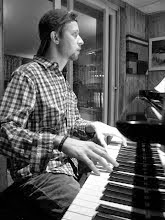
Dave is one of the premiere jazz drummers in the country. He's played with everyone from Jimmy Heath to Barry Harris to John Stetch. As a student at McGill in the 90's I would watch the local heavy weight bands of Kevin Dean and Andre White perform at Upstairs giving us all something to aspire to. Dave was and is such an important part of the top Montreal rhythm sections that it was with almost trembling fingers that I called him up on the phone in 1998 to play on a recording session of mine. After nearly 10 years of working with Dave in Montreal and being so totally schooled in feel and musicality every time I've had the chance to play with him I'd like to say that I've almost achieved on my instrument what Dave can do on the drums. Like I said I'd like to say that. Laing is one of those musicians who bring up the level of anyone he's playing with it's so easy to feel that one can really swing hard when they play music with him. Here's Dave playing with Min last year at Upstairs.

Tuesday, February 8, 2011

Sunday, February 6, 2011
Montreal Musicians I: Carlos Jimenez
I'm starting a new series of posts devoted to some of the great players that the city of Montreal has to offer. I'll start with a few musicians who've I'm lucky enough to perform with.
Maybe I'll start with a shameless plug for a band I'm in lead by the fabulous guitarist Carlos Jimenez. He's recently launched his website (www.Carlosjimenezmusic.com) and watch for his debut cd to be released in April 2011. Of course Carlos has appeared on numerous cd's as a sideman and is in regular demand in Montreal for his very capable guitar artistry. Carlos has a dark warm sound, somewhere between Jim Hall's and Adam Roger's. And I hope he doesn't mind the comparisons. His music is melodic and his soloing bears a remarkable relaxed quality even at fast tempos. I've always really enjoyed comping for Carlos and sometimes I even find myself just laying out and listening to his improvising. Another facet of Carlos which has been of particular inspiration for me is his passion for Brazilian composers. Carlos has hipped me to some amazing guitar music particularly the compositions of Guinga whose music is a bit of a specialty for Carlos. Look for an incredible track on Carlos' new disc of him performing both guitar parts of a Guinga piece for two guitars. In the meantime here's a little sample of Carlos performing in Montreal:
Maybe I'll start with a shameless plug for a band I'm in lead by the fabulous guitarist Carlos Jimenez. He's recently launched his website (www.Carlosjimenezmusic.com) and watch for his debut cd to be released in April 2011. Of course Carlos has appeared on numerous cd's as a sideman and is in regular demand in Montreal for his very capable guitar artistry. Carlos has a dark warm sound, somewhere between Jim Hall's and Adam Roger's. And I hope he doesn't mind the comparisons. His music is melodic and his soloing bears a remarkable relaxed quality even at fast tempos. I've always really enjoyed comping for Carlos and sometimes I even find myself just laying out and listening to his improvising. Another facet of Carlos which has been of particular inspiration for me is his passion for Brazilian composers. Carlos has hipped me to some amazing guitar music particularly the compositions of Guinga whose music is a bit of a specialty for Carlos. Look for an incredible track on Carlos' new disc of him performing both guitar parts of a Guinga piece for two guitars. In the meantime here's a little sample of Carlos performing in Montreal:
Thursday, February 3, 2011
Living the Jazz Dream
Recently I was interviewed in the McGill Daily for an article about the jazz scene in Montreal.
(http://www.mcgilldaily.com/2011/01/education-gets-jazzed-up/.)
I have heard several student comments and I'm glad that this article inspired a discussion about the reality of of succeeding in life as a jazz musician. I thought I would just expand and clarify some of the ideas I was quoted saying.
First of all, for some students the tone of the piece was somewhat apprehensive towards the issue of making money as a musician. I think most students are generally terrified at the idea of going out into the world and making a go of it. I would even go as far as to say that some of the allure of being an artists is to by-pass the societal pressure to earn a traditional living and eschew the value that society places on the accumulation of wealth as an indication of success.
I know it was for me. As a youth who had numerous part time jobs growing up I really liked the idea of finally getting out of school and working for myself, setting my own schedule and accomplishing my own goals. I am very grateful to the various arts councils that supported me while I was getting my skills together in my 20's. I was also able to release a CD and tour with my band during this very formative period in my life. I am also really proud that I never had to play a wedding band or go on a ship to make ends meet. Gradually as I got to be a better player I found myself working more and more as a jazz pianist in Montreal.
Eventually I started teaching a little at McGill when I went back to do my Masters in 2003 which was a really important part of this post graduate training. I was very lucky to be able to get my teaching chops together while I did my masters degree and I owe a great deal of gratitude to the faculty at McGill for sending me that teaching work which I am still doing.
Although I wasn't rich I felt that I had succeeded making a living as a jazz musician. I was playing with great players on a regular basis and continuing to grow and expand on my skills at the piano. But the general upward trend in my career development was about to hit a ceiling.
An important decision came after a couple years of touring with the young jazz vocal phenom Nikky Yanofsky. At first the gigs were sparse but gradually we were playing bigger and bigger venues. Eventually her disc was nominated for some Junos and we performed at Carnegie hall with Marvin Hamlisch conducting the New York Pops. For the first time in my life at the age of 30 I was making a decent income and even paying taxes! Gradually it dawned on me that I wanted to expand my family and that actually I had always really wanted to raise kids. All of a sudden the thought of having a child seemed to make all of this other stuff make sense. It became part of my musician's dream of success because if I could share my success with a family it would make that success even sweeter for me as well. Surprise, surprise, before you know it you're all grown up.
And then something happened to me that lead me to finally get off the fence and own the new dream of personal success. My son was born when I was 32. In a very short period of time my focus shifted from the shaping of a musical career to the shaping of a human life. Early in Max's life he experienced some health problems. They were minor but required surgery to fix. Our lives were thrown into chaos as my wife and I navigated the feelings of helplessness and anxiety that went along with this experience. All of a sudden it just didn't feel right to ditch my wife and baby son for weeks. And Nikky's schedule was beginning to become very demanding.
I got fired. Actually nobody called me up to say that my services were no longer needed. When I informed Nikky's management that I was going through a rough time with my 3 month old baby the company just replaced me and that was that. All of a sudden I wasn't getting the call after I worked with them for 2 1/2 years I was just replaced quickly and quietly.
Well that's the music biz. Sure it sucks to lose a job but what I gained from that experience was that I realized that my family would come first for the rest of my life and that not everybody I would work with would have that value. Despite portraying very publicly to the media Nikky's grounding in "family values" I know the truth about what those people are about and I cherish the path I've taking which has diverged from them.
So here's the point that I made in the article in the McGill daily. I couldn't have in a million years forseen the choices I would have to make in my future regarding my career. I couldn't have really known what I would have needed to let go of in order for me to stay true to myself. When I was 20 all I wanted was to be a jazz pianist. How that would fit into my life as a human being just wasn't on my mind. If I knew it was going to be a struggle and a challenge I certainly didn't understand the ways in which those struggles and challenges would manifest themselves.
So here's the point I make to my students: Follow your dreams but never let your dreams hold you back from living. When we grow and mature as human beings we need to allow our dreams to grow mature as well. Our dreams are a part of us. If stifled and rigidly kept in the same state as they were at a different point in our lives, our dreams may keep us from the path to success.
What is your personal definition of success?
Here's mine:

(http://www.mcgilldaily.com/2011/01/education-gets-jazzed-up/.)
I have heard several student comments and I'm glad that this article inspired a discussion about the reality of of succeeding in life as a jazz musician. I thought I would just expand and clarify some of the ideas I was quoted saying.
First of all, for some students the tone of the piece was somewhat apprehensive towards the issue of making money as a musician. I think most students are generally terrified at the idea of going out into the world and making a go of it. I would even go as far as to say that some of the allure of being an artists is to by-pass the societal pressure to earn a traditional living and eschew the value that society places on the accumulation of wealth as an indication of success.
I know it was for me. As a youth who had numerous part time jobs growing up I really liked the idea of finally getting out of school and working for myself, setting my own schedule and accomplishing my own goals. I am very grateful to the various arts councils that supported me while I was getting my skills together in my 20's. I was also able to release a CD and tour with my band during this very formative period in my life. I am also really proud that I never had to play a wedding band or go on a ship to make ends meet. Gradually as I got to be a better player I found myself working more and more as a jazz pianist in Montreal.
Eventually I started teaching a little at McGill when I went back to do my Masters in 2003 which was a really important part of this post graduate training. I was very lucky to be able to get my teaching chops together while I did my masters degree and I owe a great deal of gratitude to the faculty at McGill for sending me that teaching work which I am still doing.
Although I wasn't rich I felt that I had succeeded making a living as a jazz musician. I was playing with great players on a regular basis and continuing to grow and expand on my skills at the piano. But the general upward trend in my career development was about to hit a ceiling.
An important decision came after a couple years of touring with the young jazz vocal phenom Nikky Yanofsky. At first the gigs were sparse but gradually we were playing bigger and bigger venues. Eventually her disc was nominated for some Junos and we performed at Carnegie hall with Marvin Hamlisch conducting the New York Pops. For the first time in my life at the age of 30 I was making a decent income and even paying taxes! Gradually it dawned on me that I wanted to expand my family and that actually I had always really wanted to raise kids. All of a sudden the thought of having a child seemed to make all of this other stuff make sense. It became part of my musician's dream of success because if I could share my success with a family it would make that success even sweeter for me as well. Surprise, surprise, before you know it you're all grown up.
And then something happened to me that lead me to finally get off the fence and own the new dream of personal success. My son was born when I was 32. In a very short period of time my focus shifted from the shaping of a musical career to the shaping of a human life. Early in Max's life he experienced some health problems. They were minor but required surgery to fix. Our lives were thrown into chaos as my wife and I navigated the feelings of helplessness and anxiety that went along with this experience. All of a sudden it just didn't feel right to ditch my wife and baby son for weeks. And Nikky's schedule was beginning to become very demanding.
I got fired. Actually nobody called me up to say that my services were no longer needed. When I informed Nikky's management that I was going through a rough time with my 3 month old baby the company just replaced me and that was that. All of a sudden I wasn't getting the call after I worked with them for 2 1/2 years I was just replaced quickly and quietly.
Well that's the music biz. Sure it sucks to lose a job but what I gained from that experience was that I realized that my family would come first for the rest of my life and that not everybody I would work with would have that value. Despite portraying very publicly to the media Nikky's grounding in "family values" I know the truth about what those people are about and I cherish the path I've taking which has diverged from them.
So here's the point that I made in the article in the McGill daily. I couldn't have in a million years forseen the choices I would have to make in my future regarding my career. I couldn't have really known what I would have needed to let go of in order for me to stay true to myself. When I was 20 all I wanted was to be a jazz pianist. How that would fit into my life as a human being just wasn't on my mind. If I knew it was going to be a struggle and a challenge I certainly didn't understand the ways in which those struggles and challenges would manifest themselves.
So here's the point I make to my students: Follow your dreams but never let your dreams hold you back from living. When we grow and mature as human beings we need to allow our dreams to grow mature as well. Our dreams are a part of us. If stifled and rigidly kept in the same state as they were at a different point in our lives, our dreams may keep us from the path to success.
What is your personal definition of success?
Here's mine:

Friday, January 21, 2011
Respect yo
For the past 2 days John Patitucci has been a resident clinitian at McGill University. I, like most students, found him to be equally enlightening as a speaker as he is a player. Patitucci was really candid and warm with the students but he also called them on a few things relating to respect which I found had a profound teaching for us.
 All the clinics started early and he seemed absolutely raring to get going. However, as with many university events, the steady stream of latecomers would trickle in for the next 15 minutes or so after the designated start times. It was clear by the second clinic yesterday that this didn't sit well with Patitucci who actually stopped speaking everytime someone walked in and took the time to tell that person that it was disrespectful for them to show up late. He didn't push it further and he also didn't seem to be angry or distressed. He was just as straight-up about talking about respect as he was about talking about time or chord changes. It was just disrespectful and that was it. Teaching given.
On another occasion the student bass players were invited to play duo with Montreal's veteran pianist Steve Amirault and then receive criticism. Every bass player quickly found a tune to play with Steve and then got about their business. Some with more or less trouble due in part to the lack of drums. I don't think there wasn't a person in the room who wasn't sympathetic to the challenges of 2 musicians playing together without a drummer. As any of you who have already tried playing duo, this playing situation quickly exposes weeknesses and gaps. Only one student called a tune that Steve didn't know. It was a standard. However instead of finding another tune he kicked Steve off the piano only to replace him with a student pianist. Needless to say if there is only one standard out there which is going to make or break you it is a pretty sure sign that you're going to be in trouble in a duo situation. And of course they quickly train wrecked. In fact Patitucci quickly stopped them and laid it out bare for them to learn from their mistake.
"If you call a tune with an older player and he doesn't know it... you call another tune!"
Now maybe the first year bassist was put off by Steve and was nervous to play with him. Or perhaps that one tune was the one and only standard he knew by heart and had never tried playing tunes from memory before or sat in at a jam session. Either way it didn't seem interesting to try to play with an older more experienced player. It was somehow only important that that particular tune be played. I also noticed that both the student bass player and the student pianist left the clinic before the end when Patitucci played duo with Amirault for about 20 minutes. That was an education in playing duo and really a great chance to listen and learn given the context of the workshop.
I guess this gets to the heart of what learning is all about. There aren't a lot of situations these days when character traits such as humility and respect will actually translate into direct gains for a person. It seems to me that in most situations we are constantly trying to figure out what we can get out of it. If we do something, anything from watching tv to having a relationship, everything is done with the implicit econonmic directive: "What's in it for me?". I must admit as a tax payer I'm often yelling that question at my bills. What is problematic about this modus operandi is that it doesn't take into consideration what we need to give sometimes in order to really make growth happen. As human beings who are also jazz musicians we all want to be bad-asses. And sometimes we don't want to peer over the precipice for fear of falling. Our egos don't want us to fall because that would mean we would need to change our self-identity from "bad-ass" to "ass-bad!"
Is this an attitude that will help one learn and develop musically? Isn't playing at a really high level the surest way of insuring one's own "badassness"?
And this is another things that's great about jazz music: sometimes when we least expect it music, as it uniquly has the capacity to do, can teach us the value of humility and respect.

On another occasion the student bass players were invited to play duo with Montreal's veteran pianist Steve Amirault and then receive criticism. Every bass player quickly found a tune to play with Steve and then got about their business. Some with more or less trouble due in part to the lack of drums. I don't think there wasn't a person in the room who wasn't sympathetic to the challenges of 2 musicians playing together without a drummer. As any of you who have already tried playing duo, this playing situation quickly exposes weeknesses and gaps. Only one student called a tune that Steve didn't know. It was a standard. However instead of finding another tune he kicked Steve off the piano only to replace him with a student pianist. Needless to say if there is only one standard out there which is going to make or break you it is a pretty sure sign that you're going to be in trouble in a duo situation. And of course they quickly train wrecked. In fact Patitucci quickly stopped them and laid it out bare for them to learn from their mistake.
"If you call a tune with an older player and he doesn't know it... you call another tune!"
Now maybe the first year bassist was put off by Steve and was nervous to play with him. Or perhaps that one tune was the one and only standard he knew by heart and had never tried playing tunes from memory before or sat in at a jam session. Either way it didn't seem interesting to try to play with an older more experienced player. It was somehow only important that that particular tune be played. I also noticed that both the student bass player and the student pianist left the clinic before the end when Patitucci played duo with Amirault for about 20 minutes. That was an education in playing duo and really a great chance to listen and learn given the context of the workshop.
I guess this gets to the heart of what learning is all about. There aren't a lot of situations these days when character traits such as humility and respect will actually translate into direct gains for a person. It seems to me that in most situations we are constantly trying to figure out what we can get out of it. If we do something, anything from watching tv to having a relationship, everything is done with the implicit econonmic directive: "What's in it for me?". I must admit as a tax payer I'm often yelling that question at my bills. What is problematic about this modus operandi is that it doesn't take into consideration what we need to give sometimes in order to really make growth happen. As human beings who are also jazz musicians we all want to be bad-asses. And sometimes we don't want to peer over the precipice for fear of falling. Our egos don't want us to fall because that would mean we would need to change our self-identity from "bad-ass" to "ass-bad!"
Is this an attitude that will help one learn and develop musically? Isn't playing at a really high level the surest way of insuring one's own "badassness"?
And this is another things that's great about jazz music: sometimes when we least expect it music, as it uniquly has the capacity to do, can teach us the value of humility and respect.
Saturday, January 8, 2011
Setting goals Part I
Goals are a huge part of our Western culture. I must admit that I am myself an avid goal setter. At least I've used goal setting as a technique to accomplish lots and lots of stuff. Recently though, in the last 3 years or so, I think my goal addiction has been subdued into making lists. I have lists now... lots and lots of lists.
Goals are the focus of every credible self-help program. Stephen R. Covey's seminal book Seven Habits of Highly Effective People devotes habits 2 and 3 to goal setting:
Goals are the focus of every credible self-help program. Stephen R. Covey's seminal book Seven Habits of Highly Effective People devotes habits 2 and 3 to goal setting:
Habit 2: Begin with the End in Mind
Synopsis: Self-discover and clarify your deeply important character values and life goals. Envision the ideal characteristics for each of your various roles and relationships in life.
Habit 3: Put First Things First
Synopsis: Planning, prioritizing, and executing your week's tasks based on importance rather than urgency. Evaluating if your efforts exemplify your desired character values, propel you towards goals, and enrich the roles and relationships elaborated in Habit 2.
Goals are an enormous part of just about every useful bit of self-help technology out there. Consider this interesting presentation at a recent TED conference:
Both of the above examples of goal setting techniques have the effect of completely jazzing me up. My heart races with the thoughts of what I could accomplish with my life and how happy and fulfilled my accomplishments would make me feel. My palms start sweating when I hear "don't tell anyone your goals" and I think to myself : "that's it! The key to my success! I need a coffee. This is amazing. I need a coffee!...
Oh yeah, that's the stuff.
I love Covey's book. I'd really love the chance to go to a TED conference. However my own personal experience leads me to question the simplistic assertion that goals are what life is all about. My own dabblings in Shambahla Buddhist training makes me ask the question: Are ACCOMPLISHED people are always HAPPY people?
To be fair Covey's book also makes it a habit to be constantly tweaking your goals so that they reflect the person you are as you grow and develop. As such his idea of goals are pretty malleable. His goals are oriented towards relationships just as much as they are task accomplishment. Yet it seems to me very culturally reinforced that the achievement of tasks are what we admire the most in the west. We admire the accomplishment and loath the failure associated with career success much more publicly than, say, our accomplishments in raising children.
All I'm saying is that sometimes the harder we try to do some things the worse they get. Like when I try to play really swinging jazz or a really great solo I usually don't. But when I back off and let whatever might happen to happen that's usually when something interesting takes place. In a sense that's when my goals in music making seem the most fulfilled. Because while on the one hand my ego has a vested interest in playing great and being successful, my creative mind feels the most suppressed by my ego's desires. They are desires not based in the fulfillment of creativity but in the fulfillment of goals.
Imagine going to a party with friends and having goals for how the party will go. Having a goal for the discussions you will have. Having a goal for the success of having fun. Even if each of your goals were met wouldn't you say that you missed out on an import aspect of that experience of human interaction and co-existence due to the imposition of your agenda? How much of our lives really exists on a plane of this nature. What if the the paradigm for our existence involved letting go more of our agendas and not holding so tightly to what we want to happen and trying instead to dance with the flow of energy that surrounds us. Would we still be able to accomplish things?
I'm not saying that we shouldn't set goals for ourselves and try to accomplish success in our careers. I will always have my lists of what I'm doing on a weekly, monthly and yearly basis. I just question if whether or not most of the goals we set for ourselves are to somehow create a sense of meaning for our lives. And on a greater scale we only end up cyclically repeating patterns that ultimately cause our own suffering. This is a poignant aspect of Buddhism and one which many in the west find it difficult to reconcile. And yet at the same time we see the truth in it. Perhaps it could be my next goal to have no goals....yikes!
Imagine going to a party with friends and having goals for how the party will go. Having a goal for the discussions you will have. Having a goal for the success of having fun. Even if each of your goals were met wouldn't you say that you missed out on an import aspect of that experience of human interaction and co-existence due to the imposition of your agenda? How much of our lives really exists on a plane of this nature. What if the the paradigm for our existence involved letting go more of our agendas and not holding so tightly to what we want to happen and trying instead to dance with the flow of energy that surrounds us. Would we still be able to accomplish things?
I'm not saying that we shouldn't set goals for ourselves and try to accomplish success in our careers. I will always have my lists of what I'm doing on a weekly, monthly and yearly basis. I just question if whether or not most of the goals we set for ourselves are to somehow create a sense of meaning for our lives. And on a greater scale we only end up cyclically repeating patterns that ultimately cause our own suffering. This is a poignant aspect of Buddhism and one which many in the west find it difficult to reconcile. And yet at the same time we see the truth in it. Perhaps it could be my next goal to have no goals....yikes!
Saturday, January 1, 2011
The low cost of music...Priceless!
I'd say this video pretty much describes a major reason why musicians are struggling. It's not that we want to have lots and lots of money it's that you just can't put a price on invisible sound waves stimulating the eardrum....Enjoy!
And above all.....
Happy New Year!
And above all.....
Happy New Year!
Tuesday, December 28, 2010
Perspectives on Time III
Here are some questions that I've asked myself over the last 2 years.
Will there ever be a point at which you will say to yourself "this is it, the arrival point. I have reached my goals with my abilities as a musician." ?
Will there ever be a point at which you will say to yourself "this is it, the arrival point. I have reached my goals with my abilities as a musician." ?
What would you do if you weren't on Face book? Could this activity potentially be conflicting with an activity that would give you greater happiness?
How would you practice if you didn't have the mind that this (whatever it is you're working on) needed to get done by yesterday? Would you be more relaxed? Could this relaxed state be more productive?
How much can you accomplish in an hour, a day, a month, a year? Is your assessment really accurate?
do you set too many goals to be achieved in the short term with unrealistic expectations? As a result of this, do you then have unrealistic expectations about what can be achieved in the long term considering so many short term goals are being glossed over?
Do the things you achieve in a longer time span mean more or are more beneficial to you than the things you achieve in a shorter time span?
Subscribe to:
Posts (Atom)