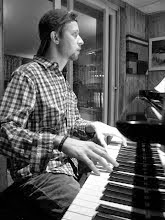
I recently sat down with John Taylor to take a lesson and try and ask as many questions as I could from this great pianist. Now almost 70 John has made a name for himself as one of Europe's most prominent pianists. He's known largely from his sideman work in groups from both North America as well as Europe. However his recent solo piano offerings (Insight, Phases, and Song and Variations) if not widely publicized or marketed have been in the Cd players of many musicians I know. Even some very heavy, non-pianist, musicians have remarked to me without prompting how much they dig those solo piano records. Lots of pianists record solo piano records but what is it about John Taylor's playing that transcends the instrument and attracts the ears of so many musicians?
I have been a fan ever since my days as a Kenny Wheeler maniac transcribing both Kenny's tunes and John's ways of blowing on them. One of Kenny's recent bands including Chris Potter and Dave Holland has toured several times in North America where we were treated to Kenny's new music including (in their live concerts only) a great straight-up blues tune by Dave Holland (the title escapes me) At the concert in Montreal in 2005 listening to John take a mammoth solo on the blues (recorded by CBC on one of the last years of JazzBeat...yes I recorded the concert off the radio so I'll listen again to hear what the title of the Dave Holland tune was) I was struck by how much of Herbie's influence I heard in John's playing. I remember at the concert feeling that all of a sudden the pieces of my appreciation for John Taylor came together. It really made sense that John Taylor was coming from such a grounded place within Jazz. It came then as no surprise to me when during our lesson it came up that Taylor was in Ronnie Scott's house band in London for 15 years. There he played with all the greats from both Europe and North America including some musicians very much grounded in the jazz tradition and language as Joe Henderson and Freddie Hubbard.
Among other things I asked John what he was working on and he showed me this little tidbit. On of his students has been incorporating some of the sounds that the French composer Messiaen used particularly his voicing of chords from the octatonic scale. John played me some left hand voicings that he's been using.
Showing posts with label The Piano. Show all posts
Friday, October 8, 2010
Saturday, October 2, 2010
Piano Voicings V
For my next installment on basic jazz piano voicings I've decided to include a simple way of looking at using chords voiced in fourths. Everybody quickly recognizes this sound and some of the greats who started using this sound exclusively back in the '60s include Chick Corea and McCoy Tyner. However the sound goes as far back as Bud Powell, George Shearing, and Dave Brubeck. Examples from the former abound but examples from the latter provide an interesting evolution of the jazz piano sound from the shell voicings of the swing era to the more modern sounds in the post-bop era. One record in particular which spans this gap is Brubeck's first solo piano record "Brubeck Plays Brubeck". While not of the same caliber of sophistication as some of the other solo pianists of his generation this record offers an interesting first recording of some of Brubeck's famous tunes like "In Your Own Sweet Way" and "The Duke". At the same time it shows the development of jazz piano out of the bebop era into more modern territory. I've included a little exercise which if practiced in 12 keys will complement the sound of the shell voicings (See my early posts "Jazz piano voicings I-IV) Have fun.Thursday, December 31, 2009
Piano Voicings IV
Here's an example of how you can use these two-hand shells to work on learning a tune. In this exercise I picked only two of the four different shell voicings (the open ones) to start with. Note that these voicings either have scale degree 5 or 9 as the top voice. Practice these chords by always keeping three notes in the right hand and two notes in the left. I'll get more into that in a follow-up post.
It's a good skill for any musician not just pianists to be able to play through a standard tune with these voicings. Getting this basic harmony together on the piano will help greatly with hearing and especially memorizing the chord changes to standard tunes. This is a tune by the great composer (and greatly under appreciated composer) and trumpeter Freddie Hubbard. Have fun!
* Note that on half-diminished chords it is possible to substitute the root for the ninth if that sounds better to you.
Saturday, December 26, 2009
Piano Voicings III: Two-Hand Shells
Moving on from the basic left hand voicings are the basic two hand shells. These voicings, aside from being a good starting point for pianists to start comping in an ensemble, also are a good way to learn about jazz voice leading. Virtually %90 of the harmony in standard tunes employs an ascending root motion in 4ths. When this occurs there is a voice exchange: 7-3, 3-7, 5-9, 9-5. Some substitutions can occur as in dominant chords when the 5th is replaced by the 13. Also extensions can be raised or lowered in certain instances as well. These shell voicings will help any musician gain a better understanding of this basic voice leading and the sounds of the altered extensions in the II-V-I cadence. I've included an excersise that I give my students where I provide the top not of the voicing and they need to complete the voicing.
Saturday, December 5, 2009
Piano Voicings II
Here's an excerpt of a transcription I made as a wee lad which is a good example of how one of the greats used these kinds of left hand voicings. The pianist is Herbie Hancock and this solo is taken from a great Bob Brookmeyer album entitled "Bob Brokkmeyer and Friends" recorded in 1963. The album features mostly standards arranged by Brookmeyer and some really great playing from Stan Getz. Herbie is also a monstrous (and pretty young) sideman. The following is the first 16 bars of Herbie's 2nd chorus from the standard "Who Cares".
The music pretty much speaks for itself especially if you listen to the rhythmic effect of using these voicings. The role of the left hand is to really achieve a swinging feel underneath the right hand improvisation. In a way if the left hand is swinging and the harmonic rhythm is together with the bass line (notice how Ron Carter easily adjusts his basslines to accompany Herbie's sudden harmonic deviations from the original changes...honestly sometimes it seems like these guys shared one brain!) then the left hand almost becomes indistinguishable from the rhythm section. Notice how the overall effect is that the two hands sound very independent from one another. This excerpt is probably one of the best examples of Herbie's approach to playing on standards from early on in his career. In it you can hear the distinctive influence of Red Garland and Wynton Kelly and yet he sounds unquestionably like himself. (This is a high resolution scan so download it to your computer and print it to see my chicken scrawl better. Now you know why I need to use Sibelius!)
Wednesday, November 4, 2009
Piano Voicings I: Basic rootless voicings
I have had several requests from people to start posting on piano voicings. This is obviously an important topic to pianists as comping is something we do 90% of the time. There is often something kind of mystical about learning voicings since they can sound complex. Personally I think all piano students should be given these things from their teachers early on so that the student doesn't develop habits that will need to be broken later. The whole business of voice-leading will take care of itself if the students learns just a couple of basic structures and really internalizes them. This will get their ears around the basic jazz voice leading (3-7, 7-3, 5-9, 9-5). Once you hear this it becomes easier to get inside the changes on a standard tune and remember the harmony because the hands will instinctually play the sounds that your hearing without too much thought. I find when a student is struggling to play voicings (especially left hand voicings while soloing) it can really get in the way of the creative flow. But it requires patience in doing a fairly un-creative practice routine until you get to the point of efortlessness and fluidity. Well take a deep breath, suck it up. If you've got a big voicing whole in your playing here are the basics. I guarantee that if you make these chords something your hands can do on their own you will have so much more mental space for your creativity. Here's Part I
Friday, October 23, 2009
Disease, Pestilence and Improvising Lines Part III
A couple of years ago I had the pleasure of taking a few lessons with NYC based pianist David Hazeltine. David is one of my favorite players for several reasons. First of all he is an example of a modern improviser who is deeply grounded in the jazz tradition. When he demonstrates a proficiency in one of several jazz piano bags (block chords, improvising lines, comping, touch on the instrument etc...) he is the "real deal". And yet I never feel when I'm listening to him that he is subjugating his musicality for "stylism". Musicians might know what I'm talking about here (especially since "stylism" isn't actually a word!) David is not concerned with showing-off his knowledge of the jazz tradition. I always get the sense that he is improvising and making music when he plays. Check out his records or better yet go see him on the bandstand and you'll be blown away by his honesty as an improviser.
This aspect of David became really apparent to me when I sat down with him in his Brooklyn studio and he demonstrated just how deep his understanding of the tradition really was. I explained to him that its sometimes just so tempting for me, after checking out a pianist all day (like playing my favorite Herbie solos...I dare anyone to hear "One Finger Snap" and not think its one of the greatest recorded solos Herbie ever made), not to go to the gig and try to do my "Herbie Impression". Its really hard because I really love that music but somehow its really not artistically honest. Sure impersonation is an important aspect of developing as a player but at a certain point it becomes a foray into what I call "stylism" when it begins to dominate your aesthetic judgements. A great stylist is always really impressive to an audience. Think of someone who is always trying to play "fast" like Oscar Peterson, or someone who is always trying to bang out loud 4ths in their left-hand like McCoy Tyner. In my own experience when I get into these states of mind I feel that I'm more or less scratching the surface of what I feel or want to express but its just a taste and not the full meal. The whole crux of the problem is how do we take our studying and love of the music, the tradition, and the players and use that knowledge to serve our needs for self-expression.
One of the things that David practiced involved a little more intuition and creativity than just rambling off licks and bits of solos. After having spent time studying the recordings of these great pianists he put all of the recordings and transcriptions aside and wrote some studies for himself that assimilated those sounds all together. These exercises are just as much a technique work out as they are way of developing a vocabulary for improvising. The great thing about playing these exercises is that after a while you can internalize a very personal rendering of the language of a great musician. I also found that the process of distilling the sounds of these musicians into a practice exercise also made me get away from spitting out licks in my solos. These little studies can really help develop an understanding of melody and time in a way that doesn't limit you to repeating anything from them in your own improvising. Enjoy!
Saturday, September 19, 2009
Improvising Lines - Part II Practicing Scales
Once the basic jazz scales have been mastered and a general understanding of the harmony they express has been grasped its time to start assembling a vocabulary of lines. The goal is to start taking our understanding of harmony and scales and using that to develop an understanding of melody. Transcribing and learning licks is one way for students to start to analyze the improvisations of the great masters in the tradition. Transcription (and more importantly learning to play our transcriptions) is definitely an important part of learning to improvise and I’ll write more about that on another blog entry. What is not at first obvious to the young improviser is how to develop an understanding of melody from licks and scales. Personally I have never sounded good spewing out a lick in the middle of a solo and nor have any of my students. It can sound kind of stilted and unconvincing especially if the melodic material in the lick doesn’t resemble anything else that is being played in the solo. What students also realize is that improvising based on an intellectual understanding of the “right” scale for the chord symbol doesn’t always yield pleasant musical results. (knowing what the “right” scale is for the chord of the moment is what Jamey Aebersold calls “Chord/scales”. For example when we see a Dmin7 chord we know that the “right” scale is D Dorian so we bust into that scale without an understand of how to create a melody that expresses D Dorian.) In other words once we have a working understanding of scales and their corresponding chord symbols it can be difficult to make it all come together musically when we improvise.
The following is an exercise that I use for University level students to start practicing scales in a way that will help more directly with improvisation. Several things are worth explaining. First of all the exercise is in a descending contour and each line expresses the sound of G(alt). However the exact scale changes depending on what note the line begins on. This is useful because unlike a lick (which must by nature always begin on the same note) practicing these lines will help you play a descending altered line beginning on one of many notes that you could find yourself on in the middle of a solo. Each line still expresses a similar altered dominant colour.
Also each example is only two bars in length which is also a lot shorter than the licks that many of my students transcribe. I have found that its more useful to develop a working and proficient understanding of melodic material that is short in length (2-4 beats) because there are more possibilities to be creative in constructing melodies with smaller, simpler pieces. This is a major distinction between this exercise and the rote practicing of licks and II-V patterns. In a sense I want to distill only one particular sound and one particular direction (descending). At the bottom I have composed a 4 bar exercise as an example of how a student can start to build on the foundation of the exercise as a whole.
Friday, September 18, 2009
Improvising Lines - Part I Jazz Scales
Learning about scales in jazz should be about complementing our own ongoing aural study of improvising. Students of jazz should already be experimenting on their instruments with the sound they hear on recordings and especially what they are hearing in their own heads. When we are first presented with scales (usually after we begin formal training) it should be with the goal of learning how to organize material that we are already working with. Scales aren’t, in other words, a means unto themselves but rather a way of putting names and categories to the sounds that we are already exploring. I believe it is always more useful to let theory coach and inform our development as improvising musicians than it is for it to become “the Source” of our information. Improvising to me is an organic, messy process and it’s really important to learn from what theory has to offer without it becoming a didactic approach that presumes there are “right” and “wrong” notes out there in the universe. That’s not to say that there aren’t “right” and “wrong” notes but that what makes something sound “right” and “wrong” goes way deeper than mere scales. Jazz music is perfectly smitten with wrong notes that bend and grind and are perfectly beautiful. So the goal in learning scales is to increase our overall literacy as musicians and thus our ability to understand at a deeper level what we are playing and, more importantly, what others are playing.
Students should learn the following scales and exercises in all 12 keys and be able to perform them musically (smoothly and without tension). I’ve also made up a few exercises for practicing scales with left hand voicings on the piano. These can be practiced by students who play any instrument as a good way of developing chops on the piano. After working out the basic technical aspects of playing scales it’s really good to take the time to really listen to them. The left hand voicings can help capture the colour and the mood of each scale. The modes especially have a lot of character and feeling to them. Playing the modes starting on the same root note often inspires me to compose. Enjoy!
Subscribe to:
Posts (Atom)


.jpg)
.jpg)


