The bellow transcription is from mm 65-70 which starts at 3:56.
Showing posts with label practicing rhythm. Show all posts
Sunday, March 29, 2015
Developing a rhythmic concept Part V: Even More Herbie!
In this example we see how Herbie uses his rhythmic concept in combination with upper structures to generate melodic material. The example was chosen because it shows both the use of triads and 4ths structures as upper structures. The first system is a vertical rendering of the melodic line to show both the type of upper structure as well as the harmonic rhythm. Note that the harmonic rhythm is displaced by a triplet eighth which we already saw in Part IV. This displacement seems to be Herbie's favourite way of playing his signature polyrhythmic groupings. I would consider to be the foundation of Herbie's rhythmic concept in general.
The bellow transcription is from mm 65-70 which starts at 3:56.
Tuesday, March 17, 2015
Developing a rhythmic concept Part IV: More Herbie!
Here is another example of the kinds of lines you can build using Herbie's Eighth note groupings. The chord progression is a II-V7-I turn around. Note that it is possible to displace the beginnings of the groupings. You can basically start on any of the 3 triplet subdivisions. Also by combining eight and quarter note triplets you can create larger grouping. This quickly becomes complex as it modulates the meter. So make sure when you're practising longer phrases that you teach yourself how to resolve metrically modulated phrases. As you'll see the more complex your rhythmic concept the more easily it is to train wreck your solo!
Sunday, January 25, 2015
Developing a rhythmic concept II
This week we are going to continue with some examples of how to use our polyrhythmic groupings. For this exercise I've changed the harmonic/melodic colour to the Lydian mode. Although the result might sound a little "new age-y" you might use it to begin to see the possibilities of applying a rhythmic concept to any chord/scale. Next post we'll take a look at how one of my favourite jazz pianists, Herbie Hancock, uses polyrhythmic groupings in his solos.
Tuesday, October 7, 2014
Strengthening your inner pulse: Think like a drummer part IV
This will be the last instalment in this series. For more ideas and exercises please check out the fantastic book by drummer Pete Magadini called Polyrhythms for musicians. The following study should be as always performed with the metronome and keep your foot tapping!
Friday, September 26, 2014
Strengthening your inner pulse: Think like a drummer part III
If you've become as excited as I have about subdivisions then feast your eye
s on this! But seriously aren't you turning into the best lap drummer you know? Enjoy….
Wednesday, September 17, 2014
Strengthening Your Inner Pulse: Think like a drummer part II
When I listen to the drummers in Montreal that I have the great pleasure of regularly performing with I am constantly amazed at how effortlessly they can play ideas using different rhythmic subdivisions simultaneously throughout the kit. For example, he might comp phrases on the snare drum that have a quarter note triplet subdivision against a ride cymbal pattern that has 4/4 feel. A drummer can also hint at another "feel" while simultaneously playing another feel. As far as playing concepts and ideas on the kit, the drummers I've spoken with have told me they spend a lot of time dealing with subdivisions which is the beginning of how they build complexity on their instrument that doesn't sound random but relates back to something fundamental like the basic swing feel.
In the three against two exercise for this week we now subdivide the quarter-note triplet in 3 creating a new grouping of 9 against 2 (or 4 if you're tapping eighth notes with your foot). Once you get this going notice how it creates the sensation of 2 simultaneously occurring "feels" in your body. Your inner pulse must deal with both subdivisions of the beat. You might start by mathematically placing the second quarter note of the bar between the 5th and 6th triplet triplet subdivision. However after a while you'll want to achieve a flow with both your feet and your hands and should try to hear them as two simultaneous and related rhythms. Take note how the odd number of notes in a bar creates a 2-bar phrase between your right and left hands.
Try and compose lines on your instrument with these rhythmic groupings and see how that changes your soloing. Have fun!
In the three against two exercise for this week we now subdivide the quarter-note triplet in 3 creating a new grouping of 9 against 2 (or 4 if you're tapping eighth notes with your foot). Once you get this going notice how it creates the sensation of 2 simultaneously occurring "feels" in your body. Your inner pulse must deal with both subdivisions of the beat. You might start by mathematically placing the second quarter note of the bar between the 5th and 6th triplet triplet subdivision. However after a while you'll want to achieve a flow with both your feet and your hands and should try to hear them as two simultaneous and related rhythms. Take note how the odd number of notes in a bar creates a 2-bar phrase between your right and left hands.
Try and compose lines on your instrument with these rhythmic groupings and see how that changes your soloing. Have fun!
Thursday, September 11, 2014
Strengthening Your Inner Pulse: Think Like a Drummer
Put down and step away from your instruments....What does it mean to have an inner pulse? Often, it is said that since we all have a heart that beats then we all have an inner pulse. While this is true on a physiological level I've notice that improvising jazz musicians grapple with a sense of pulse in their playing. That is to say that we are deeply concerned not just with the notes we play or their rhythmic subdivisions but the phrasing and feel of what we are playing and how it relates to what other musicians are playing too. Also how much of a presence does our playing have? Do we have a big robust and confident voice when we solo? Or do our solos sometimes sound thin and weak? Are we really expressing our ideas and having an impact on an audience?
I've always been jealous of drummers for playing an instrument that forces them as musician to work directly with an inner pulse. Since the drums are the least forgiving to those who play with a weak sense of time and rhythm, drummers must work really hard to play with a good time feel. I've noticed that the conviction and rhythmic clarity with which drummers play almost always connects well with the audience. It almost begs the question: Why do us non drummers approach practicing our instruments in different ways rhythmically? Does having a heart beat mean that inner pulse will take care of itself in my playing?
What it would be like to play the piano but think like a drummer? I developed the following exercises for my piano students to work on away from their instrument. I think these exercises would equally apply for any instrumentalist who wonders what it would feel like to think like a drummer. Many of my students tell me that practicing like this lets them concentrate in a different way. It helps them to eliminate all of the built up "piano" stuff that their fingers naturally go to when they practice. When returning to the piano after practicing these exercises one also hears what one is playing from a fresh rhythmic perspective. I should also mention that these were largely inspired by adapting material from a great book on rhythm by the west coast drummer Pete Magadini entitled: Polyrhythms, the musician's guide.
The firs exercise below is preparatory for harder stuff to come. For now concentrate on the feeling of your limbs working together to create a relaxed and swinging time feel. Have fun!
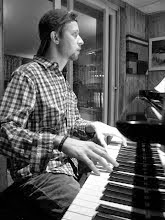
I've always been jealous of drummers for playing an instrument that forces them as musician to work directly with an inner pulse. Since the drums are the least forgiving to those who play with a weak sense of time and rhythm, drummers must work really hard to play with a good time feel. I've noticed that the conviction and rhythmic clarity with which drummers play almost always connects well with the audience. It almost begs the question: Why do us non drummers approach practicing our instruments in different ways rhythmically? Does having a heart beat mean that inner pulse will take care of itself in my playing?
What it would be like to play the piano but think like a drummer? I developed the following exercises for my piano students to work on away from their instrument. I think these exercises would equally apply for any instrumentalist who wonders what it would feel like to think like a drummer. Many of my students tell me that practicing like this lets them concentrate in a different way. It helps them to eliminate all of the built up "piano" stuff that their fingers naturally go to when they practice. When returning to the piano after practicing these exercises one also hears what one is playing from a fresh rhythmic perspective. I should also mention that these were largely inspired by adapting material from a great book on rhythm by the west coast drummer Pete Magadini entitled: Polyrhythms, the musician's guide.
The firs exercise below is preparatory for harder stuff to come. For now concentrate on the feeling of your limbs working together to create a relaxed and swinging time feel. Have fun!
Labels:
Inner pulse,
jazz rhythms,
Pete Magadini,
practicing rhythm
Subscribe to:
Posts (Atom)


